Why does last mile delivery software fail in peak season?
Peak season does not break last mile delivery software because shoppers suddenly become mysterious creatures.
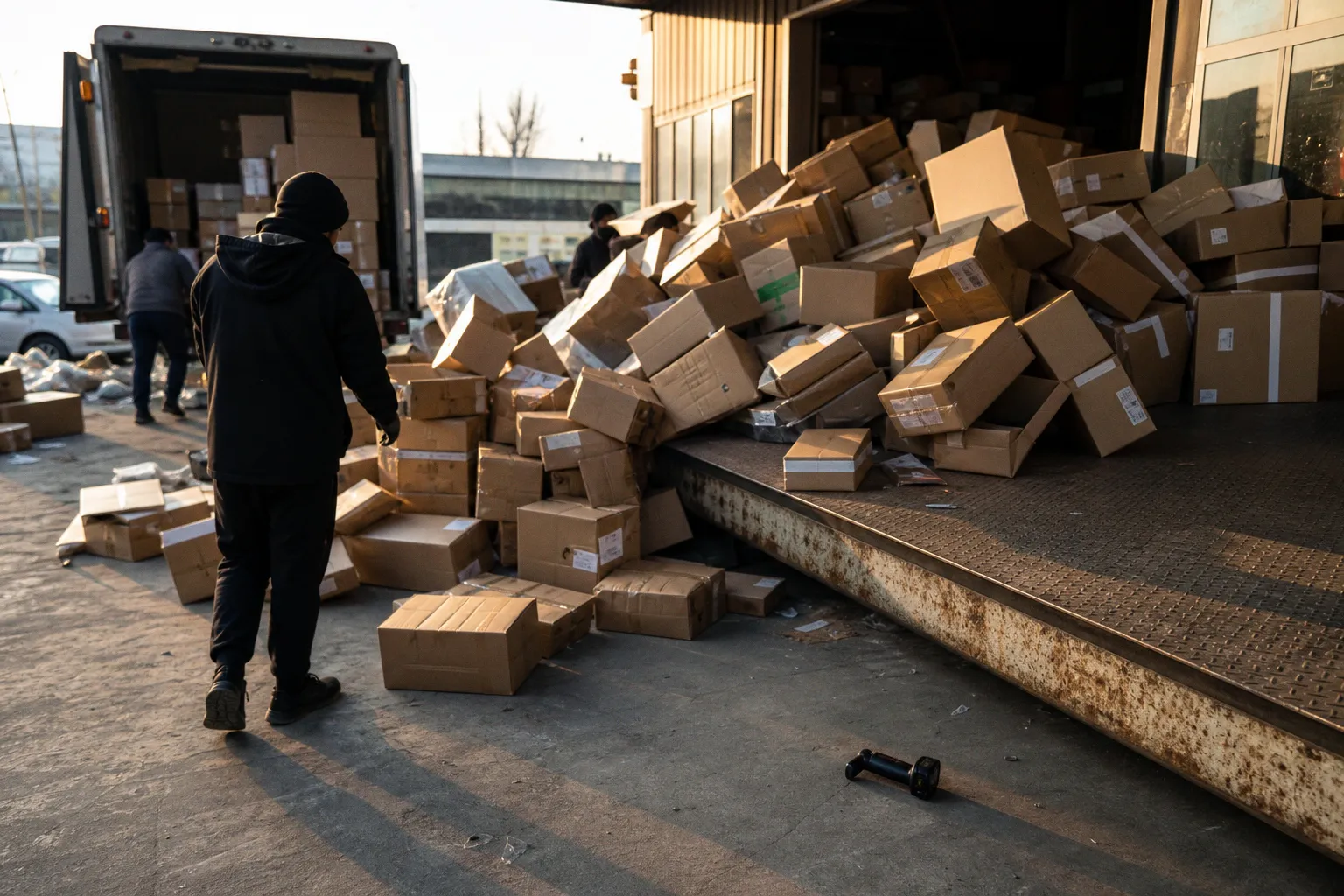
That is the ugly part operators learn every November. A platform that looked fine in September can fold when delivery volume jumps by up to 400%. The warehouse can still pick-and-pack. The vans can still roll. But the software layer between the dock door and the doorstep starts turning simple work into expensive noise: stalled routes, frozen dispatcher screens, missing driver pings, duplicate customer service tickets, and reattempts that eat $10 to $15 a pop.
The anatomy of a 400% peak season surge
Peak season traffic is not just “more orders.” That phrase is too soft. More orders means more labels, more scans, more route stops, more customer refreshes, more driver app sessions, more exception events, and more angry humans asking where the box is.
A normal Tuesday might let a final mile delivery platform breathe. Orders flow in. Routes get built. Drivers update stops. Customers check tracking once or twice. Dispatch can fix the odd address issue with a phone call and a manual drag-and-drop.
Then November hits.
Volume can climb by up to 400%, and the pattern changes. The system does not get a smooth, polite increase. It gets lunch-hour spikes, evening tracking surges, weather-related bunching, carrier cut-off compression, and frantic warehouse waves that dump thousands of parcels into routing at once.
The load is messy because the operation is messy. That is not an insult. It is freight.
A last mile stack has to absorb several traffic types at the same time:
- Customer tracking refreshes from people checking the same parcel over and over.
- Driver location pings from mobile apps moving through bad network zones.
- Route planning requests from dispatch teams trying to rebuild overloaded territories.
- Proof-of-delivery uploads, photos, signatures, notes, and failed-attempt codes.
- Customer service lookups from agents trying to answer “where is it?” before the buyer cancels.
- API calls to mapping, geocoding, traffic, carrier, and notification services.
Each of those requests looks harmless in isolation. Together, they behave like a forklift traffic jam at a dock with one working bay door.
The worst platforms fail because they were sized around average load, not peak-hour load. Average load is a comforting lie. It hides the burst. It hides the 5 p.m. tracking stampede. It hides the warehouse wave that releases too many orders into routing in a ten-minute window. It hides the customer service team opening 300 order records after a weather delay.
Peak season punishes systems built for neat charts.
Average traffic does not pay your reattempt bill. Peak-hour traffic does.
The operational damage starts before the system fully crashes. Dispatchers wait three seconds for screens that used to load in half a second. Route recalculations stall. Driver apps spin. Customer tracking pages show stale data. The service desk starts refreshing manually, which adds even more read traffic. The software does not need to go dark to cost money. It only needs to slow down enough to make everyone work twice.
Database contention: the read-write bottleneck nobody wants to own
Most peak failures begin in the database, because that is where optimism goes to die.
Under normal load, a query that takes 100 milliseconds may be annoying but survivable. During peak, that same query can stretch past two seconds when the database is fighting simultaneous read and write pressure. Now the delay spreads. The app waits. The dispatcher screen waits. The driver update waits. The tracking page waits. Then retries start, and retries are gasoline.
This is where last mile delivery software gets exposed. The read/write pattern becomes violently asymmetric. Customers and customer service teams generate huge read volume: tracking refreshes, order status checks, ETA views, driver location lookups. At the same time, the operation needs writes to keep moving: route creation, order status updates, stop sequencing, delivery confirmations, exception codes.
If reads sit on the same overloaded primary database as operational writes, the system chokes on its own visibility layer. That is a bitter little irony. The last mile tracking tool meant to reduce support tickets can starve the write capacity needed to update the delivery record in the first place.
A clean architecture routes read-heavy traffic to replicas. Tracking pages, customer service views, dashboard refreshes, and non-critical analytics should not be shoulder-checking route creation and delivery confirmation writes on the same resource. When they do, dispatch pays for it.
Here is how the pressure usually shows up on the floor:
| Failure point | What operators see | Cost impact |
|---|---|---|
| Slow tracking reads | Customers refresh repeatedly or contact support | Higher ticket volume, more labor hours |
| Blocked route writes | Dispatch cannot create or adjust routes fast enough | Late departures, overtime, missed windows |
| Delayed driver updates | Stops show stale status or wrong ETA | Bad customer promises and failed handoffs |
| Database retries | App traffic multiplies under stress | Wider outage risk and more infrastructure spend |
| Reporting queries on live data | Dashboards slow the actual operation | Management gets numbers while drivers wait |
The fix is not glamorous. Index the ugly queries. Kill the vanity dashboard running against production during dispatch windows. Separate reads from writes. Cache tracking responses where real-time precision does not change the decision. Set a hard threshold for query optimization before peak; if something is already floating above 100 milliseconds in calm weather, it is not ready for November.
No operator enjoys paying for database work because it does not photograph well in a board deck. But it is cheaper than paying drivers to sit, paying support to apologize, and paying $10 to $15 for every failed reattempt that better software timing could have avoided.
API rate limits: when your route engine depends on someone else’s gate
The next failure is usually external. Delivery route optimization software often depends on mapping, geocoding, traffic, and address validation APIs. Google Maps and similar services are deeply useful. They are also not magic pipes with infinite flow.
At peak, routing engines can hit contracted rate limits when call volume surges up to 10x. That is not a theoretical platform risk. It is a dispatch-floor problem. If the routing engine cannot geocode addresses, pull traffic data, or calculate drive times at the moment routes need to go out, the morning sort turns into a staring contest.
A bad setup makes external APIs part of the critical path for every decision. Every route recalculation calls out. Every address correction calls out. Every ETA refresh calls out. Every driver app screen may trigger another request. Then the rate limit hits, timeouts start, and the platform behaves as if the whole world disappeared.
Better teams negotiate rate limits before peak. They cache aggressively. They pre-geocode known addresses. They store stable coordinates instead of re-asking for the same answer like a nervous intern. They degrade gracefully when live traffic data is unavailable. Maybe the ETA gets less precise for a few minutes; the dispatch screen should not die because a third-party service said “slow down.”
This is where we need to separate software sales language from operational value. A vendor can call itself “AI-powered,” “real-time,” or “autonomous” until the invoice ink dries. If the route engine locks up because a mapping API throttled it, that vocabulary belongs in the bin.
The useful questions are plain:
1. Which external APIs sit in the critical dispatch path?
2. What happens when they throttle, lag, or return partial data?
3. Are common addresses cached before peak?
4. Are API limits contracted against actual peak-hour bursts, not monthly averages?
5. Can dispatch continue with degraded routing instead of no routing?
That last point matters. Static routing is not dead, despite what some vendors imply. It is just not enough by itself for volatile peak work. A sane operation keeps fallback logic. If dynamic routing stalls, you still need a workable route, even if it is less elegant. A slightly inefficient route that leaves the depot beats a perfect one trapped inside a timeout.
Synchronous processing turns small delays into pileups
A lot of dispatch software for e-commerce fails because too much work happens synchronously. That sounds technical, but the warehouse-floor translation is simple: everybody waits in the same line.
If order status updates, route recalculations, driver locations, notification sends, and exception processing all block the user interface until each task finishes, peak traffic will expose it. Dispatchers click. The system waits on a downstream service. Drivers submit proof of delivery. The app waits on upload, status write, notification trigger, and maybe a customer-facing tracking update. One delay becomes five delays.
Message queues exist for a reason. Non-critical or heavy work should move asynchronously so the core operation does not freeze. Accept the driver update. Queue the downstream notification. Process the analytics later. Do not make a dispatcher stare at a loading spinner because the system is trying to satisfy every dependency before returning control.
The same logic applies to customer-facing tracking. Customers do not need a database-shredding live query every time they tap refresh. Many tracking events can tolerate short caching windows. The customer wants confidence, not a direct straw into the primary operational database.
Peak systems need to prioritize by operational value:
- Route creation and stop sequencing should outrank dashboard decoration.
- Driver confirmation writes should outrank marketing notification enrichment.
- Dispatcher control should outrank customer refresh spam.
- Exception triage should outrank non-urgent reporting.
- Mobile app resilience should outrank perfect data sync in a bad signal zone.
High-density delivery areas add another ugly layer. Mobile networks get congested. Drivers lose stable connectivity. Apps fail mid-confirmation. A rushed driver taps the wrong code, skips a photo, or retries an upload three times. If the app cannot handle offline capture, delayed sync, duplicate prevention, and edge cases in proof-of-delivery flows, the data turns dirty fast.
Dirty data becomes operational shrinkage. Not inventory shrinkage in the classic warehouse sense, but margin shrinkage: time lost reconstructing events, customer credits issued because proof is missing, reattempts booked because an access issue was not captured properly, and service reps digging through half-synced records.
The last mile is not a software demo. It is a driver with 148 stops, a weak signal, and a customer texting support every six minutes.
Exception cascades are where margin goes missing
At normal volume, teams get away with sloppy exception handling. A failed delivery, access issue, wrong apartment code, vehicle breakdown, damaged parcel, or missing recipient becomes a manual fix. Dispatcher calls the driver. Customer service emails the buyer. Someone updates a note. The package goes back out tomorrow.
That works until exceptions multiply.
During peak, exception volume can surge 10x. The problem is not just the count. It is the coordination load. Every exception touches routing capacity, driver time, customer communication, inventory visibility, and sometimes reverse logistics. If the software treats exceptions as loose notes instead of operational workflows, the queue becomes a swamp.
Failed first-time deliveries are already expensive. In the U.S., the average first-time delivery failure rate was 8% in 2020, and every reattempt can cost retailers $10 to $15 in driver time, fuel, and customer service. That number hurts more during peak because the network has less slack. A reattempt is not just a reattempt. It steals capacity from new orders that were supposed to move cleanly.
This is where weak last mile delivery software turns a recoverable miss into a cascade:
- A driver marks “recipient unavailable,” but the app does not trigger a customer rescheduling flow.
- The customer tracking page stays vague, so the buyer contacts support.
- Support cannot see the driver note because sync failed.
- Dispatch manually reassigns the parcel without a confirmed time window.
- The second attempt fails for the same reason.
- The order now carries extra delivery cost, support cost, and churn risk.
That is not a customer experience issue first. It is a cost-control issue. Customer experience is the polite wrapper. The P&L is the bruise.
Automated exception handling does not mean removing humans. It means humans stop doing clerical cleanup that software should trigger. A good final mile delivery platform should push failed deliveries into specific flows: reschedule, redirect to pickup, request access code, validate address, return to sender, hold for customer contact, or reroute to another driver if the window still works.
The key is reducing open-ended work. “Investigate” is not a workflow. It is a labor sink.
A practical exception stack needs:
- Standardized reason codes that drivers can use quickly without guessing.
- Customer-facing rescheduling links sent automatically after eligible failed attempts.
- Dispatch rules that decide whether a parcel can be rerouted same-day.
- Alerts for repeated address failures, not just single failed stops.
- Offline-capable driver notes and proof capture.
- Audit trails clean enough for support to act without calling the depot.
None of this is exciting. That is the point. Peak survival is built out of boring controls that stop small failures from breeding.
Load testing cannot be a ceremonial checkbox
Many logistics teams test too late, too lightly, or not at all. Then November becomes the test, which is a bold strategy if you enjoy burning cash in public.
A serious peak readiness program runs 6 to 8 weeks before the season. Not three days before the first promotional wave. Not after the first outage. Six to eight weeks gives engineering, operations, and vendor teams enough time to fix what breaks.
The test target should be 3 to 5 times expected peak traffic, using realistic peak-hour patterns rather than a smooth uniform load. Uniform testing is almost useless for last mile operations because real demand lands in clumps. Warehouses release batches. Customers check tracking after work. Drivers upload proof around delivery wave completions. Weather delays compress activity into ugly windows.
Testing should include the whole operating mess:
| Test area | What to simulate | Why it matters |
|---|---|---|
| Customer tracking | Repeated refreshes and order lookups | Read traffic can starve operational writes |
| Driver app | Location pings, POD uploads, offline sync | Mobile failures create bad delivery records |
| Routing engine | Batch route creation and recalculation | Dispatch cannot wait during depot release |
| External APIs | Throttling, timeouts, partial responses | Rate limits can halt routing if uncached |
| Exceptions | 10x failed deliveries and access issues | Manual triage collapses under peak volume |
| Support access | Hundreds of agents viewing orders | Service tools add database pressure |
The test should answer uncomfortable questions. Which query goes from 100 milliseconds to two seconds? Which API limit gets hit first? Which interface blocks when a queue backs up? Which customer notification storm creates more reads? Which driver app action duplicates records after retry? Where does the dispatcher lose control?
Operators should also test degraded modes. This is where many platforms reveal whether they were built by people who understand logistics or people who only understand demos.
If mapping APIs slow down, can routes still be built with cached coordinates? If the driver app loses connection, can proof of delivery be captured offline and synced once? If tracking traffic surges, can customer pages serve cached status without hammering the primary database? If exception volume spikes, can the platform auto-sort issues instead of dumping them into one giant manual queue?
The answer does not have to be elegant. It has to be executable.
Peak 2024 showed that even with strain, the market can still move freight: November on-time performance was reported at 84%, with average delivery time around 3.7 days. Those numbers are not a free pass. They show the bar customers now expect while networks are running hot. If your software layer falls over, you are not competing against theory. You are competing against operators who kept enough system endurance to ship on time.
The real reason systems fail: bad cost math before the season
Most peak failures are not surprises. They are unpaid bills from earlier decisions.
Somebody did not pay for read replicas. Somebody postponed query cleanup. Somebody accepted API limits based on average traffic. Somebody let routing depend on live external calls without caching. Somebody treated message queues as “phase two.” Somebody assumed manual exception handling would stretch. Somebody ran a load test shaped like a pancake instead of a peak-hour freight spike.
Then the system fails, and everyone acts shocked.
The hard truth is that last mile delivery software does not need infinite scale. It needs scale where the operation actually hurts. That means read-heavy tracking, write-sensitive dispatch, mobile driver workflows, external routing dependencies, and exception automation.
If you operate e-commerce fulfillment, the ROI case is blunt. Add up failed reattempts at $10 to $15 each. Add overtime when routes leave late. Add customer service labor when tracking stalls. Add credits and refunds after vague delivery failures. Add deadhead miles from bad rerouting. Add lost capacity when drivers burn time on second attempts instead of clean first deliveries.
Now compare that to the cost of fixing the known bottlenecks before peak.
The better investment usually looks boring:
1. Optimize slow database queries before they become outage triggers.
2. Separate read traffic from write-critical operational flows.
3. Cache customer tracking and geocoding data where precision does not require a fresh call.
4. Negotiate external API limits against burst load, not average volume.
5. Move non-critical processing into queues so dispatch and driver workflows do not block.
6. Build automated exception flows for failed deliveries, access issues, and rescheduling.
7. Load test 3 to 5 times expected peak traffic with real spike patterns 6 to 8 weeks early.
That list will not impress a conference panel. It will keep vans moving.
The last mile is where e-commerce promises get converted into physical work. Boxes need labels. Drivers need routes. Customers need honest status. Dispatchers need tools that respond when the day is already sideways. Peak season does not forgive fragile systems because the website had a strong conversion rate.
If the software cannot survive the surge, the cost lands in the same old places: labor, fuel, refunds, support tickets, missed delivery windows, and margin shaved thin enough to see through. The fix is not more slogans about real-time logistics. It is paying down the operational debt before November shows up with a crowbar.