Speed Up Last-Mile Delivery with Automated Route Batching
In 2024, last-mile delivery consumed 53% of total shipping costs. That figure was 41% six years prior. The trajectory is unambiguous: the final leg of e-commerce logistics is where margins are built or destroyed.
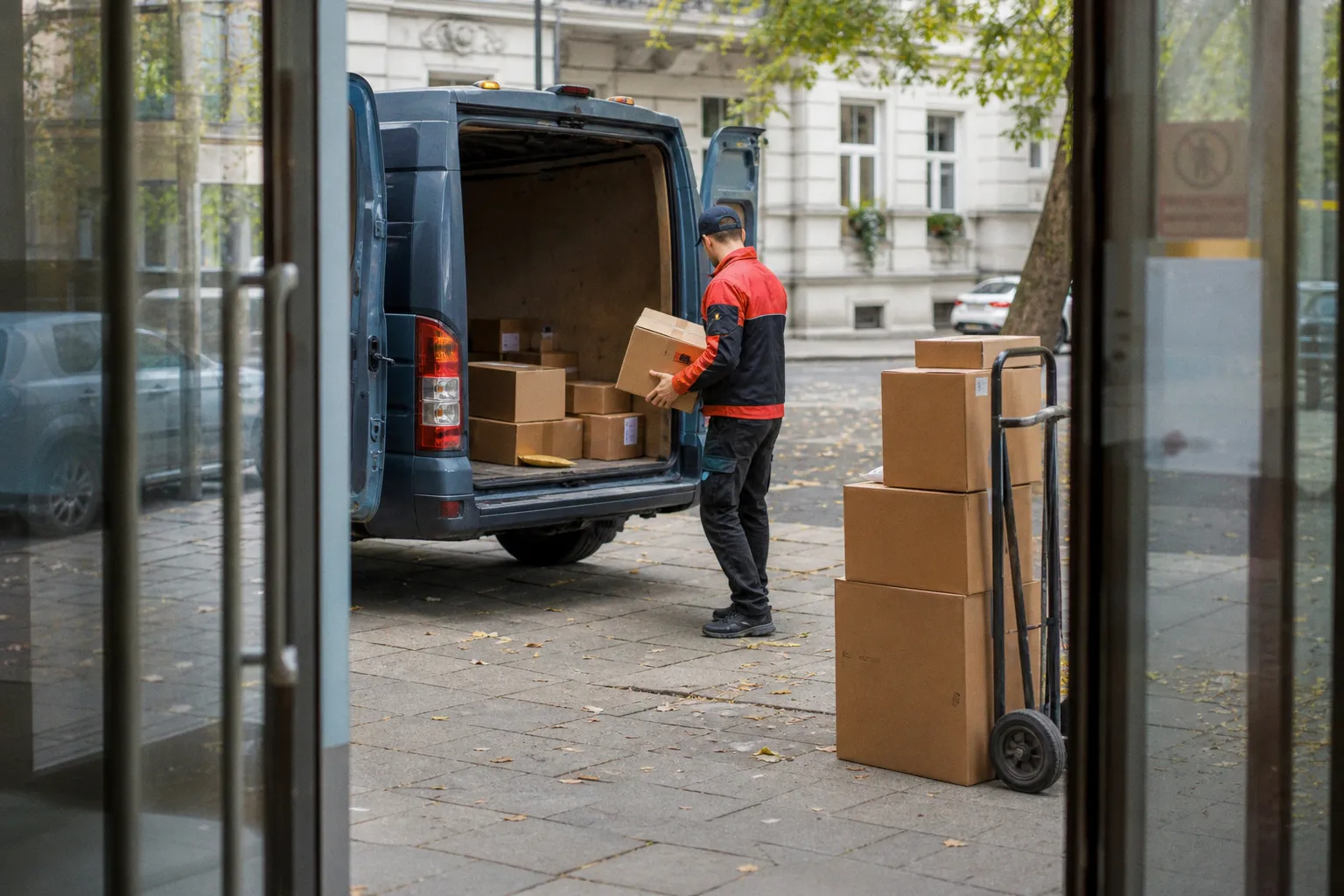
In 2024, last-mile delivery consumed 53% of total shipping costs. That figure was 41% six years prior. The trajectory is unambiguous: the final leg of e-commerce logistics is where margins are built or destroyed. Operators still routing manually — dispatcher on headset, driver on intuition — are bleeding cost at a rate that automated batch-processing systems have already proven they can cut by 20–30%.
This is not a trend piece. It is a system audit. What follows is a breakdown of where the cost lives, how automated route batching compresses it, and what implementation requires at the operational level.
The Economic Reality of the 53% Shipping Margin
Most e-commerce operators understand that shipping is expensive. Few understand where the expense concentrates.
Last-mile delivery — the segment from the final distribution hub to the customer's door — has become the single largest cost node in the fulfillment chain. Its share rose from 41% of total shipping expenditure in 2018 to 53% in 2024. The drivers are structural:
- Labor accounts for 50–60% of last-mile cost. Drivers, loaders, vehicle operators — this is human-capital-intensive work that resists simple automation. Route optimization does not eliminate labor; it compresses the wasted portion of labor hours.
- Urban density increases parcel volume but also increases failed delivery friction. In North America and Europe, urbanization rates sit at approximately 81%. More parcels, more addresses, more parking violations, more elevator waits.
- Consumer expectations have outpaced infrastructure. Data indicates 80% of shoppers expect same-day delivery. The fulfillment network was not designed for that cadence.
The margin problem is geometric. A dispatcher handling 50 drivers with 30 stops each is making 1,500 sequential routing decisions per shift. Each suboptimal decision — wrong time window, inefficient clustering, overlap between adjacent routes — compounds. Small routing errors at scale become structural cost.
The last mile is not a logistics problem. It is a combinatorial optimization problem that human brains solve poorly at scale.
Automated route batching attacks this directly. It replaces heuristic decision-making with deterministic computation. The system does not get tired at 2 PM. It does not favor a familiar route. It does not miss a time-window constraint because the phone rang.
Order Clustering and the Geometry of Pickup Efficiency
Route batching works by converting individual delivery requests into grouped dispatch units — clusters — before assigning them to drivers. The computational objective is straightforward: minimize total travel distance while satisfying every delivery time window and capacity constraint.
The operational benefit is measurable. Order clustering and automated batch dispatch workflows reduce last-mile pickup distances by up to 13%. That is not a marginal gain. On a fleet processing 5,000 daily deliveries, a 13% distance reduction translates to fewer vehicle-hours, lower fuel consumption, and reduced per-parcel cost.
The mechanics:
1. Geospatial clustering. Orders within defined radii are grouped before routing begins. The system assigns parcels to clusters based on proximity, delivery-window overlap, and vehicle capacity — not on order of receipt.
2. Dynamic time-window matching. Each cluster is validated against customer-specified delivery windows. Parcels that conflict are re-allocated. This prevents the common failure mode where a driver arrives at an address during a window the customer specified as unavailable.
3. Capacity-aware load balancing. Clusters are sized to vehicle payload limits. No driver receives 40 packages when the van carries 30. This sounds obvious; manual dispatch violates it daily.
4. Sequential optimization within clusters. Once clustered, each driver's stop sequence is computed for minimum travel time — not minimum distance. The distinction matters: the shortest geographic path may route through congestion zones, one-way streets, or school zones at peak hours.
The result is a routing plan that is simultaneously tighter (fewer deadhead kilometers) and more reliable (higher on-time delivery rate). AI-powered route planning generates multi-stop routes 20% faster than traditional methods and reduces manual planning errors by up to 90%.
| Parameter | Manual Dispatch | Automated Batch Routing |
|---|---|---|
| Route computation time | 30–90 min per shift | < 5 min for full fleet |
| Planning error rate | Variable, operator-dependent | Reduced by up to 90% |
| Pickup distance efficiency | Baseline | 13% reduction in avg. distance |
| Time-window compliance | Dependent on dispatcher recall | Deterministic, constraint-based |
| Scalability | Linear cost increase with fleet size | Near-constant marginal cost |
| Fuel efficiency | Baseline | 10–15% reduction |
The table above oversimplifies slightly — implementation quality varies — but the directional numbers are consistent across published benchmarks. The system does not need to be perfect. It needs to be less wrong than a fatigued human dispatcher at scale.
Mitigating the $17.78 Penalty of Failed Delivery Attempts
A failed delivery is not a zero-event. It costs money, and the cost is quantifiable.
The average cost of a single failed delivery attempt is $17.78. That figure includes the driver's wasted time, the return-to-hub mileage, the re-scheduling labor, and the customer service interaction that follows. For an operation processing 10,000 deliveries per day with a 5% failure rate, the daily penalty is $8,890. Monthly: $266,700. Annual: over $3.2 million burned on parcels that did not reach the recipient on the first try.
Failed deliveries cluster around predictable failure modes:
- Time-window violations. The driver arrives outside the customer's stated availability. This is the most common cause and the most preventable with automated scheduling.
- Address ambiguity. Apartment complexes, new construction, rural routes with inconsistent GPS data.
- Absent recipient. Signature-required packages delivered when no one is home.
- Access failure. Gated communities, locked lobbies, intercom systems that do not work.
Automated route batching addresses the first and most expensive category directly. By embedding time-window constraints into the routing algorithm at the cluster-formation stage, the system ensures that delivery attempts are sequenced to match when customers are actually available. This is deterministic attribution of delivery windows to route sequences — not a dispatcher guessing.
Dynamic route planning has demonstrated the potential to decrease delivery times by up to 40% in high-frequency sectors such as food delivery. The same principles — real-time re-sequencing based on traffic data, order density, and driver position — apply to parcel logistics. The difference is that parcel delivery tolerates wider time windows, which gives the optimizer more degrees of freedom to work with.
A $17.78 failed delivery is a system failure, not a driver failure. The system that sent the driver to the wrong address at the wrong time is the liability.
Additional mitigation techniques that integrate with batch routing:
1. Pre-delivery confirmation triggers. SMS or app-based confirmation two hours before the delivery window, allowing the customer to reschedule before the driver departs.
2. Real-time re-routing. If a customer modifies their time window mid-route, the system re-optimizes the remaining stops without manual intervention.
3. Geofenced delivery logging. GPS-verified proof of delivery location, reducing disputed deliveries and chargeback fraud.
4. Predictive absence modeling. Historical data on customer availability patterns fed back into time-window assignment for repeat customers.
Each of these is a data input or output of the batching system, not a standalone feature. The value is in the integration — a closed loop where delivery outcomes inform future routing decisions with decreasing error rates over time.
Transitioning from Manual Dispatch to AI-Driven Workflows
Implementation is where most operators stall. The technology exists. The economics are proven. The obstacle is operational inertia — dispatchers who have run routes for years, drivers who trust their own navigation over an app, and management teams that underinvest in integration.
The transition is not binary. It is sequential.
Phase 1: Data infrastructure. The batching system requires structured input — order data, address coordinates, time-window specifications, vehicle capacity parameters, and historical delivery outcomes. If this data lives in spreadsheets, email threads, or a dispatcher's memory, it must be digitized first. This is unglamorous work. It is also non-negotiable.
Phase 2: Parallel execution. Run automated routing alongside manual dispatch for 4–6 weeks. Compare outcomes: delivery time, failed attempt rate, fuel consumption, driver overtime hours. The data speaks. Operators who skip this phase and switch cold invariably revert within a quarter because they lack the baseline to prove the system works.
Phase 3: Dispatcher role transformation. The dispatcher does not disappear. Their function shifts from route computation to exception management. The algorithm handles the 95% of routing decisions that are computationally tractable. The human handles the 5% that involve construction detours, vehicle breakdowns, customer escalations, and judgment calls the system cannot yet process.
Phase 4: Feedback-loop closure. Delivery outcome data — on-time rate, first-attempt success, customer ratings — feeds back into the routing model. Clusters are re-weighted. Time-window predictions improve. The system gets measurably better every month, provided the data pipeline is clean.
For operators exploring digital tools and platform integrations that support logistics automation, resources covering digital services and mobile solutions can provide useful technical context for evaluating software options.
The critical error in most implementations is treating automation as a software purchase rather than a process redesign. Buying routing software and plugging it into unchanged workflows produces unchanged results with a licensing fee.
Scaling Operations for the Same-Day Delivery Era
The market pressure is not abstract. 91% of consumers actively track their packages in real-time. Tracking is no longer a feature; it is a baseline expectation. What follows tracking is the expectation that the delivery arrives within a narrow, predictable window — same-day where feasible, precise time-slot where not.
This creates an operational equation that manual systems cannot solve:
- Same-day delivery requires order cutoff times as late as possible to maximize order capture.
- Late cutoffs compress the time available for picking, packing, and routing.
- Compressed timelines demand routing decisions made in minutes, not hours.
- Routing decisions at that speed must be automated or they will be wrong.
Automated batch routing is the only scalable answer to this equation. The system accepts orders in real-time, clusters them as they arrive, assigns them to available vehicles, and computes optimized stop sequences — all within the latency window required for same-day dispatch.
Labor remains the dominant cost variable at 50–60% of total last-mile expense. Automation does not eliminate labor costs. It reallocates labor from low-value decision-making (which route is faster?) to high-value execution (delivering the package correctly on the first attempt). Driver retention improves when workloads are balanced, routes are predictable, and the system does not assign them impossible schedules.
The scaling math:
1. Fleet utilization. Automated routing increases stops-per-hour by eliminating deadhead travel and optimizing sequences. Fewer vehicles needed for the same volume.
2. Cost predictability. Manual dispatch cost variance is high — dependent on dispatcher skill, shift load, and daily order mix. Algorithmic routing produces consistent per-parcel cost within a narrow band.
3. Geographic expansion. Adding a new delivery zone with manual dispatch requires hiring and training a new dispatcher who knows the area. Automated systems require only the geodata and time-window inputs; zone knowledge is computational, not tribal.
4. Peak-load handling. Holiday surges, flash sales, and promotional spikes overwhelm manual systems. Automated batching scales compute resources in parallel with order volume. The marginal cost of processing an additional 1,000 orders in the routing system is near zero.
Without route optimization, projected urban delivery emissions increase by 30% by 2030. Regulatory pressure on fleet emissions is already shaping carrier contracts in European markets. Operators who cannot demonstrate route efficiency will face surcharges, access restrictions, or exclusion from municipal delivery programs.
Binary Summary
Technical advantages:
- 20–30% reduction in delivery costs through optimized clustering and sequencing.
- 13% reduction in pickup distances via order batching workflows.
- Up to 90% reduction in manual planning errors.
- Up to 40% reduction in delivery times with dynamic re-routing.
- 10–15% fuel savings from distance compression.
- $17.78 per failed delivery eliminated at scale through time-window compliance.
Technical constraints:
- Requires structured data infrastructure; no data, no automation.
- Dispatcher role transformation creates short-term organizational friction.
- Algorithm performance depends on data quality — garbage in, routing garbage out.
- Does not solve driver shortages directly; improves retention through workload balance.
- Shortest-distance routing is not always optimal; time-window compliance is the binding constraint.
The system is not speculative. The numbers are published. The technology is deployed at scale by operators processing millions of parcels monthly. The question for any e-commerce business still routing manually is not whether to automate — it is how much margin they are willing to lose before they do.